
Choosing which ANSI grade lock to purchase differs greatly depending on what you use the door for and what type of building it’s in. However, understanding the ANSI grades themselves isn’t as complex as you may think.

What Are ANSI Lock Grades?
The American National Standards Institute, or ANSI, describes itself as ‘a private, non-profit organization that administers and coordinates the U.S. voluntary standards and conformity assessment system.’
For our conversation on ANSI grades, this means that ANSI accredits the process used to develop these standards, while the Builders Hardware Manufacturers Association (BHMA) develops the applicable builders-hardware standards and administers a certification program that uses independent laboratory testing.
These standards are used to create three grades of locks.
Grade 1, Grade 2, and Grade 3 at a Glance
While standards alone shouldn’t be the basis of your decision for lock grades, here are the standards at a glance for cylindrical locks:
ANSI Grades at a Glance
| Criteria | Grade 1 | Grade 2 | Grade 3 |
|---|---|---|---|
| Operational | Lock latches closed with 4.5 pounds of force or less. Handle rotates with 28 inch-pounds of force or less. | ||
| Cycles | 1 million cycles | 800,000 cycles | 800,000 cycles |
| Strength | Handles 360+ pounds of pressure and still works. | ||
| Security | Handles 10 blows of 75 ft.-lbf | Handles 5 blows of 75 ft.-lbf | Handles 2 blows of 75 ft.-lbf |
| Material | Trim has an impact of 0.075 in. when stabbed with a probe. | Trim has an impact of 0.100 in. when stabbed with a probe. | Trim has an impact of 0.100 in. when stabbed with a probe. |
Cylindrical lock comparison. On smaller screens, scroll horizontally to see all grades.
What Is an ANSI Grade 1 Lock?
ANSI grades 1 and 2 are both considered to be commercial locks, while grade 3 is used primarily for residential applications. The grade 1 lock has a focus on durability, longevity, and strength.
Grade 1 is the highest ANSI performance grade for cylindrical locks and is generally intended for demanding, high-traffic environments where the hardware will see frequent use. These locks are commonly used in schools, hospitals, government buildings, institutional facilities, and other commercial spaces where durability and long-term reliability are especially important.
A Grade 1 lock may also be the better choice for exterior doors, heavily used entrances, or applications where additional resistance to physical force is desired. For lower-traffic commercial spaces, however, a Grade 2 cylindrical lock can often provide adequate performance at a lower cost.
Grade 1 vs. Grade 2 Locks
The difference between Grade 1 and Grade 2 isn’t just in their price tag. The standards ANSI sets were created to provide resistance against real-life situations and risks when it comes to your security.
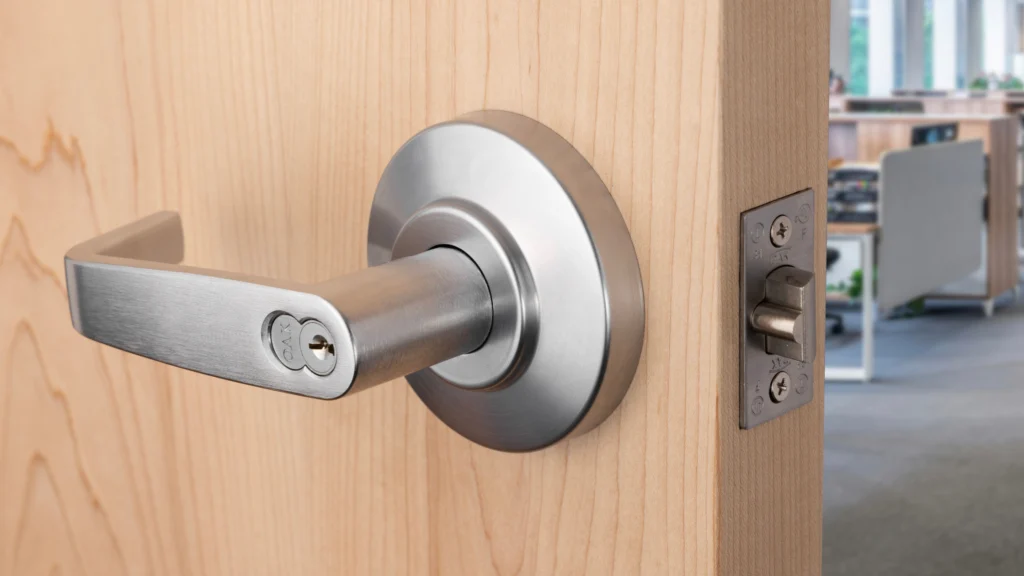
Durability and Traffic
Grade 1 locks are typically reserved for high-traffic areas and heavy use. Grade 2 is usually installed in doorways that experience light use. Lightly used doors could be supply closets or offices, while high-traffic doors could be an entrance or hallway door.
When thinking in terms of ANSI standards, this is where cycles come into play. Cycles are measuring against the wear that happens to the lock when the handle is rotated, pushed/pulled, and the door latches as it closes. Doors that experience a lot of use may work through cycles much more quickly and require a sturdier, Grade 1 lock.
Security and Strength
However, durability should be considered in tandem with security. A lock may be durable, but lacking in strength when attacked. These tests make sure a lock can withstand several methods of forced entry. That is why ANSI standards measure against blows to the door and lock.
You may have a doorway that isn’t heavily used, but requires a great deal of security. For instance, server rooms are only accessed by a select few and don’t experience much use, but require a higher level of security. The same could be true if a door is usually held open, but needs to remain sturdy in case the door is closed during a lockdown.
Understanding Deadbolt Grades
It is worth noting that while deadbolts also operate on Grade 1 and Grade 2 categories like commercial locksets, the standards change slightly. The main differences are regarding the number of cycles for each.
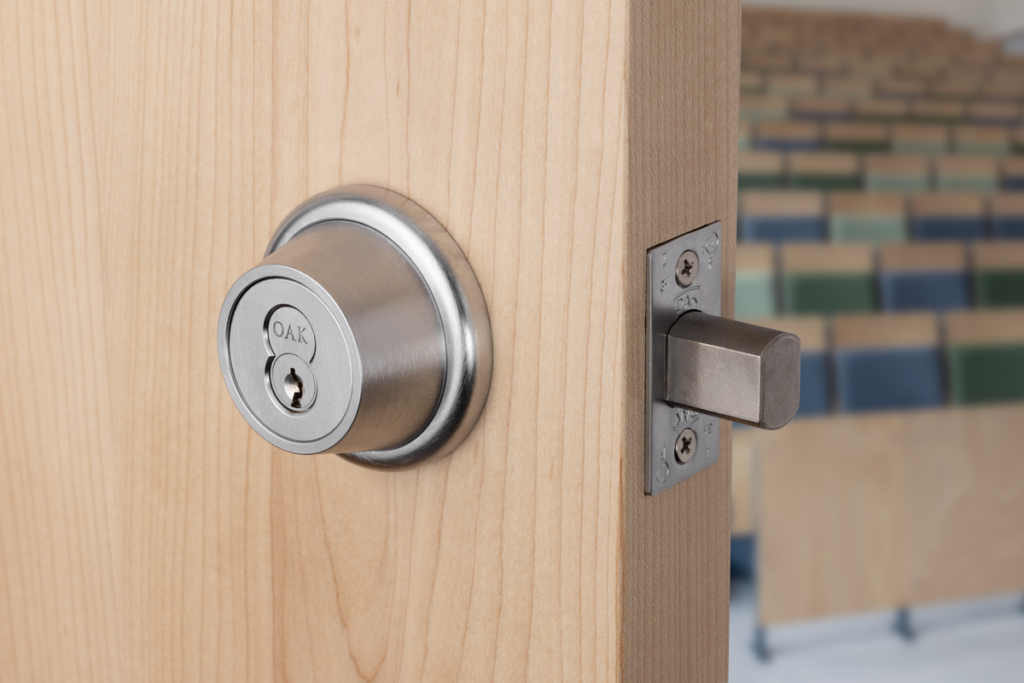
Grade 1 Deadbolt vs. Grade 2 Deadbolt
A Grade 1 deadbolt and a Grade 2 deadbolt are distinguished primarily by the number of cycles. An ANSI Grade 1 deadbolt is rated to withstand 250,000 cycles, while the Grade 2 is rated for 150,000. However, this does not mean that Grade 1 deadbolt locks are weaker than the Grade 1 Cylindrical Lock rated for 1 million cycles.
The deadbolt security grades measure the extraction and extension of the bolt. The deadbolt isn’t gripped and yanked when opening the door or easily torqued. As a result, these deadbolts are designed to hold up in the same environment as their graded lock counterparts.
Does ANSI Grade 1 Mean a Deadbolt Is Bump Proof?
When considering different grades of deadbolts, a common concern that arises is whether or not a Grade 1 deadbolt is bump-proof. “Bumping” a lock is a process where someone can take a modified key, insert it into the lock, and “bump” the key with a small bumping hammer. The result is that the sharp edge of the bump key forces the pin segments in the lock to jump into position and unlock the door.
While there are methods to protect against lock bumping, ANSI Grades focus on direct physical attack and long-term wear to the lock. Methods that involve lock picking or bypassing the key system within a lock are not a focus of the ANSI Grades. However, there are ANSI standards that provide pick resistance and other high-security standards. In this case, you should consider locks meeting standard UL 437.
When Should You Use Grade 1 vs. Grade 2?
ANSI Grade standards don’t necessarily make it clear which grade lock you should use unless you know how many cycles your lock goes through a day or how many pounds of force someone is bound to use on the lock. Even then, “Tests described in. . . Standard(s) are performed under laboratory conditions. In actual usage, results vary…”
More practical considerations for whether to use a Grade 1 or Grade 2 include your door’s exposure to a potential attacker, traffic patterns, potential abuse, code requirements, and lifecycle cost.
For instance, any exterior doors are at risk of attack and should have a Grade 1 lock. Doors that experience high traffic or could experience heavy abuse from users, such as hallway doors in a high school, will likely need Grade 1 locks as well.
How to Choose the Right Door Lock Security Grade
If there are no external criteria that are forcing you to pick a certain ANSI Grade, the decision can certainly have a preferential aspect to it as well. Do your door locks tend to break or levers sag? Upgrading your lock may prevent you from having to work on or replace your locks as often.
But if you’re still not sure, we offer professional recommendations via our territory management team that can help you think through what your facilities need. Give them a call at 317-391-3203.